
What Another Season of Neglect Actually Costs You
Skip this checklist one more time and the bill isn't hypothetical. A garage door that buckles in high wind doesn't just leave a hole in your house for rain to pour through — it changes the pressure inside your entire garage and attic space in a way that can peel back roof decking and blow out windows from the inside. Add in a flooded garage floor from a failed bottom seal, a soaked opener motor that shorts out, or rollers so rusted from humidity they seize mid-storm and strand your car outside, and a "minor" garage door problem turns into a multi-system repair. None of that is rare once wind gets involved — it's the predictable result of ignoring the door until it fails.
Why the Garage Door Is a Home's Weakest Wall
Every other exterior wall on your house is a continuous, fastened structure. The garage door is the one wall that's designed to move — a large panel held in place mostly by tension springs, roller tracks, and a motor, not by framing nailed into studs. That's exactly why it's the first thing to go in sustained high wind. Once it flexes inward or outward past its limit, the tracks bend, the panels pop out of the rollers, and the door can no longer resist pressure at all. At that point wind gets inside the garage, and a space that's supposed to be sealed becomes a wind tunnel pushing up against your roof structure from underneath.
The Piedmont Wind Problem, Specifically
This part of North Carolina doesn't get hurricanes directly, but it absolutely gets their remnants — tropical systems that weaken over land but still arrive with sustained wind, torrential rain, and gusts that spike well past what a worn-out door was ever built to handle. Combine that with the heavy rain that's typical here in fall, pollen-slicked tracks from earlier in the year, and the humidity that lingers around garages built close to pine cover, and you get a door that's already compromised before the storm even arrives.
The Pre-Storm Inspection: What to Actually Check
- Panels and seams: Look for dents, warping, or separation at the panel joints. Even a small dent changes how the door handles wind load.
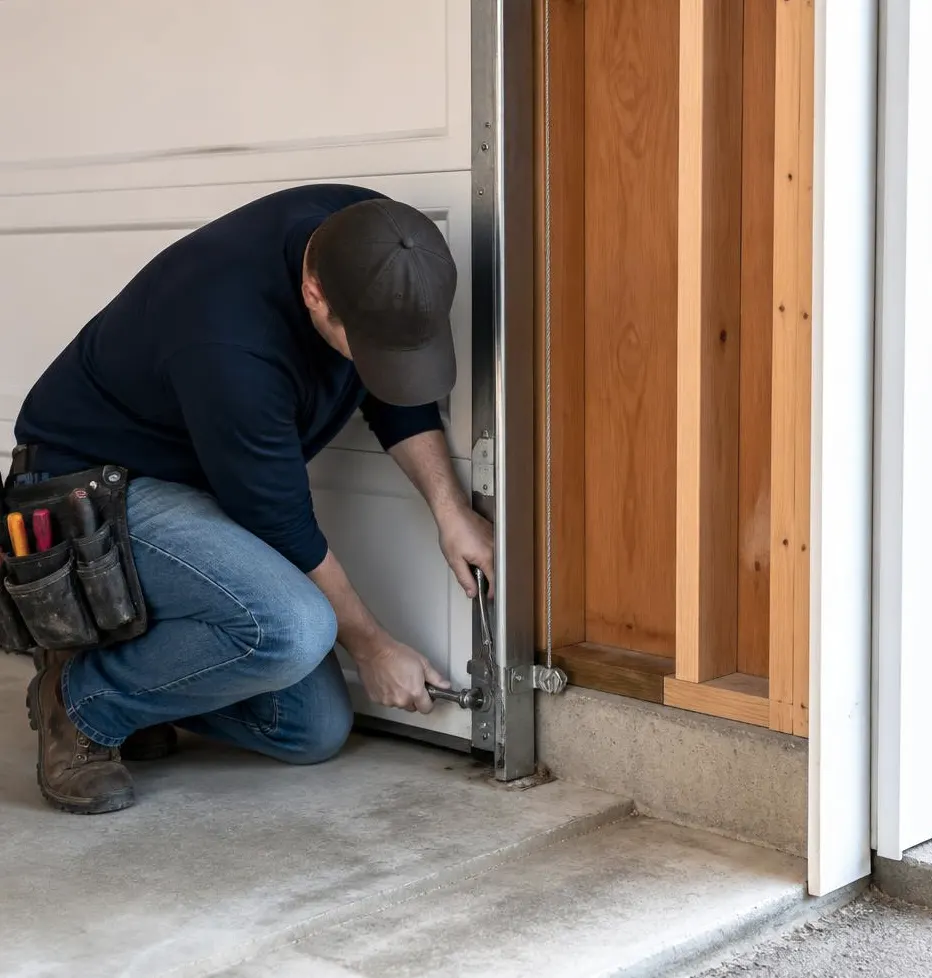
- Tracks: Check for rust (common after humid summers and heavy rain), bending, or gaps where the track has pulled away from the wall. A door can only resist wind pressure if the tracks hold it in place.
- Rollers and hinges: Rusted or worn rollers bind under stress instead of moving smoothly, putting extra strain on the opener and the track during high wind.
- Weatherstripping and bottom seal: Cracked or compressed seals let wind-driven rain pour under the door. This is the single easiest fix with the biggest payoff before a storm.
- Springs: Rusted, stretched, or visibly uneven springs won't hold the door's weight evenly, which matters a lot if the door is being pushed by wind while also trying to open or close.
- Opener and battery backup: Remnant storms frequently knock out power before they knock out wind. If your opener doesn't have battery backup, you may be stuck manually operating a door mid-storm — check that the manual release cord works smoothly now, not during an outage.
Reinforcement: What's Worth Doing Before Wind Season Peaks
If your door is otherwise sound, horizontal or vertical strut reinforcement kits (generally a few hundred dollars installed, depending on door size and material) add real wind resistance without replacing the door. They work by stiffening the panels so they can't bow inward under pressure. For older doors, especially steel doors without any internal bracing, this is usually the better trade-off than a full replacement.
If the door is already dented, rusted through at the tracks, or the springs are original to a house that's more than 10-15 years old, reinforcement is putting money into a door that's still going to fail somewhere else. In that case a wind-rated replacement door (national ranges typically run from the low thousands into the mid-thousands depending on size, material, and insulation) is the more honest fix, and it also tends to seal better against the heavy rain this region gets.
Don't Forget the Auto-Reverse Safety Check
Before storm season, confirm your opener's auto-reverse still works — place a block of wood under the door and make sure it reverses on contact. This isn't just a safety feature for kids and pets; a door that doesn't reverse properly is often a sign the opener is already straining, which is exactly the kind of mechanism you don't want failing when you need to close the door fast ahead of incoming wind.
When to Call Greensboro Garage Door Pro
If your inspection turns up rust on the tracks, uneven springs, a seal that's cracked or missing in sections, or an opener without battery backup, that's the time to call before the next remnant storm rolls through — not after. Our Preventive Maintenance service covers exactly this: track alignment, roller and hinge condition, spring tension, and weatherstripping, so you know where the door actually stands before wind puts it to the test. If a storm has already come through and left you with a door that won't open, a bent track, or a spring that let go, our Emergency Garage Door Service gets a tech out fast rather than leaving your garage exposed overnight.
Greensboro Garage Door Pro serves homeowners and businesses throughout Greensboro, High Point, Burlington, Kernersville, Summerfield, Oak Ridge, Pleasant Garden, and McLeansville, NC. Call us before the next storm front moves through — or the moment one already has.